
Clinical Safety
Treatment readiness, biological monitoring, overlapping toxicities, emergency actions, contrast reactions and CTCAE documentation.
Regimen safety check
Select one or more agents to reveal prerequisites, follow-up and overlapping toxicity domains. No patient data are stored.
Select treatment components to reveal prerequisites, monitoring and combined toxicity signals.
5-Fluorouracil (5-FU)
Safety gates
Current FDA labeling recommends DPYD testing before fluorouracil unless treatment is immediately necessary. Complete DPD deficiency is a major safety contraindication.
In France, uracilemia testing before the first prescription has been mandatory since 2019; the prescription workflow must document that the result was considered. Interpret uracilemia cautiously in moderate/severe renal impairment.
Monitoring schedule
Emergency actions
- Withhold 5-FU immediately.
- Assess for severe mucositis, diarrhea, cytopenia, neurotoxicity and DPD deficiency.
- Escalate according to local fluoropyrimidine-toxicity protocol.
- Withhold 5-FU.
- Urgently assess mental status and serum ammonia.
- Initiate ammonia-lowering/supportive treatment per emergency protocol.
Capecitabine
Safety gates
Current FDA labeling recommends DPYD testing before capecitabine unless treatment is immediately necessary.
French prescribing/dispensing rules require uracilemia before first fluoropyrimidine prescription and documentation that the result was considered.
Assess renal function before treatment; renal impairment changes exposure/dose suitability.
Monitoring schedule
Emergency actions
- Withhold capecitabine.
- Assess DPD-related toxicity, dehydration, renal function and blood counts.
- Escalate urgently for severe diarrhea, mucositis, cytopenia, neurotoxicity or cardiac symptoms.
Cisplatin
Safety gates
Document serum creatinine/renal function and the regimen-specific creatinine-clearance eligibility threshold. Do not apply one universal cutoff across all protocols.
Ensure protocol-appropriate hydration; magnesium and other electrolytes require active surveillance.
Monitoring schedule
Emergency actions
- Stop cisplatin immediately.
- Activate local anaphylaxis/resuscitation protocol.
- Do not rechallenge until specialist review.
- Withhold treatment.
- Urgently correct clinically significant electrolyte abnormalities and assess renal injury/volume status.
- Escalate according to severity and local protocol.
Carboplatin
Safety gates
Document the renal-function method used for AUC/formula dosing; impaired renal function increases myelosuppression risk.
Hypersensitivity risk rises with prior platinum exposure and later cycles; emergency medication/equipment must be available.
Monitoring schedule
Emergency actions
- Stop carboplatin immediately.
- Activate local anaphylaxis/resuscitation protocol.
- Document platinum allergy and obtain specialist review before any future platinum exposure.
Paclitaxel
Safety gates
Use the exact product/regimen protocol: solvent-based paclitaxel and albumin-bound paclitaxel are not interchangeable for premedication or dosing.
Document neuropathy and blood counts before treatment; cumulative neuropathy may require modification.
Monitoring schedule
Emergency actions
- Stop infusion immediately.
- Activate local hypersensitivity/anaphylaxis protocol.
- Further taxane management requires specialist review.
- Stop infusion and aspirate without flushing.
- Follow agent/formulation-specific extravasation pathway; current ONS/ASCO guidance supports hyaluronidase for paclitaxel/docetaxel extravasation.
- Use the locally specified compress strategy and follow-up.
Bevacizumab
Safety gates
Surgical timing and wound healing must be checked against the active bevacizumab label/protocol before treatment.
Do not start the monitoring pathway without baseline blood pressure and renal/proteinuria context.
Monitoring schedule
Emergency actions
- Stop bevacizumab.
- Urgent surgical/acute-care assessment.
- Manage sepsis/peritonitis according to emergency protocol.
- Stop treatment.
- Activate appropriate emergency pathway.
- Do not resume without specialist reassessment and label/protocol review.
Pembrolizumab
Safety gates
Establish liver enzymes, creatinine and thyroid function before treatment and recognize relevant pre-existing autoimmune/endocrine conditions.
Monitoring schedule
Emergency actions
- Hold pembrolizumab while severity and alternative causes are assessed.
- Activate the organ-specific immune-toxicity pathway; severe cases may require urgent admission and immunosuppression per guideline/label.
- Do not treat a potentially serious immune toxicity as routine chemotherapy nausea/diarrhea/dyspnea.
- Stop infusion.
- Activate local hypersensitivity/anaphylaxis protocol.
- Future dosing depends on reaction severity and label guidance.
Mitomycin C (IV)
Safety gates
Use reliable venous access and continuous site vigilance. Extravasation can cause delayed extensive necrosis.
Document blood counts and renal function before treatment; toxicity is cumulative.
Monitoring schedule
Emergency actions
- STOP infusion immediately. Leave the access in place initially to attempt gentle aspiration; DO NOT flush.
- Elevate a peripheral limb when applicable; mark/measure and photograph the area.
- Use a cold compress strategy and apply DMSO according to the current local/agent-specific protocol where available.
- Arrange early surgical/plastic-surgery escalation for high-risk, extensive, central-line, progressive or necrotic injury; continue structured follow-up because necrosis may be delayed.
- Stop mitomycin and do not give another dose pending evaluation.
- Urgently assess CBC/platelets, hemolysis markers and renal function.
- Escalate to acute hematology/nephrology care.
Contrast reaction readiness
Rare reactions are exactly why the first response should be rehearsed. This section follows the current ACR adult reaction card and ESUR preparedness principles.
Anaphylaxis / hypotension with tachycardia
Recognize: Hypotension, tachycardia, respiratory distress, diffuse erythema/urticaria or rapid multisystem reaction after contrast.
- Preserve IV access and monitor vital signs continuously.
- Give oxygen 6–10 L/min by face mask.
- Elevate legs and give 0.9% normal saline rapidly.
- Adult ACR card: epinephrine 0.3 mg IM (1 mg/mL) or, with IV access and appropriate expertise, 0.1 mg IV (0.1 mg/mL) slowly into a running IV infusion; repeat per current ACR/local protocol.
- Activate the emergency response / CODE BLUE pathway.
ACR Adult Contrast Reaction Card (current page accessed 2026)
Laryngeal edema / inspiratory stridor
Recognize: Inspiratory stridor, progressive throat/facial swelling or airway compromise.
- Preserve IV access and monitor vital signs.
- Give oxygen 6–10 L/min by face mask.
- Administer epinephrine according to the current ACR adult reaction card/local protocol.
- Activate CODE BLUE / airway support immediately.
ACR Adult Contrast Reaction Card
Bronchospasm
Recognize: Expiratory wheeze, dyspnea or reduced air entry after contrast administration.
- Preserve IV access and monitor vital signs.
- Give oxygen 6–10 L/min by face mask.
- Give a beta-2 agonist inhaler; ACR adult card uses 2 puffs and allows repeat dosing.
- If severe or not responding, use epinephrine according to the current ACR/local protocol.
- Activate emergency response for severe/persistent symptoms.
ACR Adult Contrast Reaction Card
Hypotension with bradycardia / vasovagal reaction
Recognize: Hypotension with bradycardia, pallor, diaphoresis or typical vasovagal symptoms.
- Preserve IV access and monitor vital signs.
- Give oxygen 6–10 L/min by face mask.
- Elevate legs and give IV 0.9% saline.
- For refractory adult bradycardia/hypotension, the current ACR adult card lists atropine 0.6–1.0 mg IV.
- Escalate if not promptly resolving or if diagnosis is uncertain.
ACR Adult Contrast Reaction Card
Hives / diffuse erythema / angioedema
Recognize: Urticaria, erythema or angioedema without initial cardiorespiratory compromise.
- Preserve IV access and observe; monitor vital signs.
- If skin-only findings are severe or progressive, consider an H1 antihistamine according to local/ACR guidance.
- If hypotension, bronchospasm or respiratory distress appears, immediately switch to the anaphylaxis pathway.
ACR Adult Contrast Reaction Card; ESUR contrast safety guidance
Contrast extravasation
Recognize: Pain, swelling, tightness or visible contrast leakage at the injection site.
- Stop injection and assess the limb/site.
- Elevate the affected extremity to heart level and apply a cool compress.
- Remove rings or constricting items.
- Observe and document.
- Obtain urgent surgical assessment for decreasing perfusion, sensation, strength, active range of motion, progressive swelling or increasing pain.
ACR Adult Contrast Reaction Card / Manual on Contrast Media
Visual toxicity recognition
Small canonical morphology examples help residents describe what they actually see before assigning a diagnosis. Images are teaching examples, not diagnostic substitutes.

Morphology example only (miliaria), useful for recognising papules and erythema — not an oncology diagnosis.
CDC / Dr. Lester Cordes · Public domain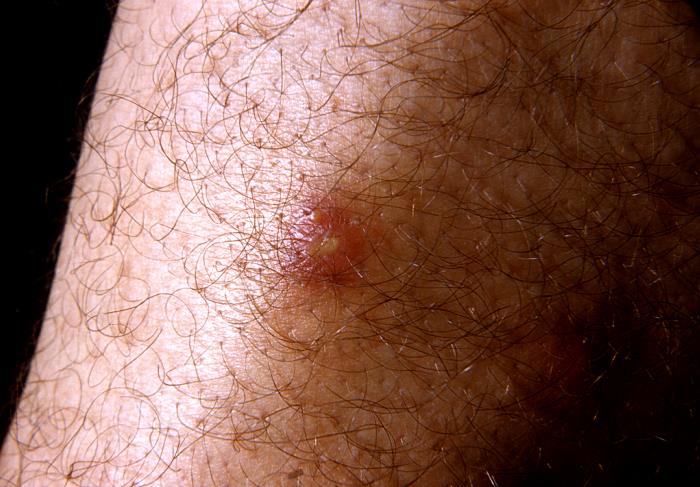
Morphology example only: a discrete pustule with an erythematous halo.
CDC / Dr. Harold G. Scott · Public domain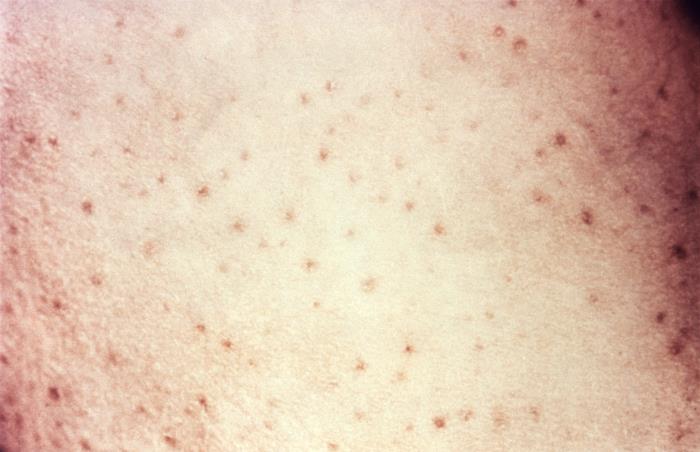
Useful for distinguishing small non-blanching hemorrhagic lesions from inflammatory erythema.
CDC · Public domain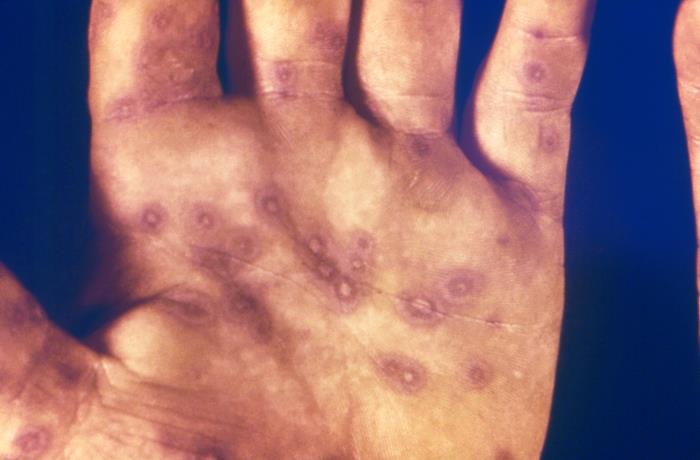
Targetoid morphology can overlap with severe cutaneous adverse-reaction differentials; mucosal involvement or systemic illness raises urgency.
CDC / Dr. N.J. Fiumara · Public domain
Morphology example only (herpes labialis). Use to recognise small fluid-filled vesicles.
CDC / Dr. Hermann · Public domain
High-risk visual red flag. Painful rash, mucosal or ocular involvement, epidermal detachment or systemic illness warrants urgent specialist/emergency assessment.
James Heilman, MD · CC BY-SA 3.0Painful rapidly progressive rash, mucosal or ocular involvement, epidermal detachment, targetoid lesions with systemic illness, or extensive blistering/desquamation should trigger immediate treatment hold where clinically appropriate and urgent specialist/emergency assessment. Do not wait for a perfect dermatologic label before escalating.
Describe it correctly in the patient file
Use the exact CTCAE term and grade definition. The documentation helper does not infer a grade automatically in this preview.
- Stop the infusion immediately.
- Keep the access in place initially for gentle aspiration of residual drug; do not flush.
- Assess the site and neurovascular status; for peripheral injury, elevate the limb when applicable.
- Measure, outline and photograph the affected area; document drug, concentration, estimated volume and time.
- Apply the agent-specific compress/antidote pathway — warm/cold treatment is not interchangeable.
- Escalate early for severe, high-volume, central-line, progressive, necrotic or function-threatening injury.
ONS/ASCO supports agent-specific antidotes and early specialty/surgical escalation for high-risk injury. For mitomycin, DMSO is an agent-specific option in the current ONS/ASCO algorithm; local extravasation kits and protocols should be immediately available.
Early unusually severe fluoropyrimidine toxicity
- Withhold 5-FU immediately.
- Assess for severe mucositis, diarrhea, cytopenia, neurotoxicity and DPD deficiency.
- Escalate according to local fluoropyrimidine-toxicity protocol.
Hyperammonemic encephalopathy
- Withhold 5-FU.
- Urgently assess mental status and serum ammonia.
- Initiate ammonia-lowering/supportive treatment per emergency protocol.
Early unusually severe fluoropyrimidine toxicity
- Withhold capecitabine.
- Assess DPD-related toxicity, dehydration, renal function and blood counts.
- Escalate urgently for severe diarrhea, mucositis, cytopenia, neurotoxicity or cardiac symptoms.
Severe hypersensitivity / anaphylaxis
- Stop cisplatin immediately.
- Activate local anaphylaxis/resuscitation protocol.
- Do not rechallenge until specialist review.
Acute severe renal/electrolyte toxicity
- Withhold treatment.
- Urgently correct clinically significant electrolyte abnormalities and assess renal injury/volume status.
- Escalate according to severity and local protocol.
Acute hypersensitivity / anaphylaxis
- Stop carboplatin immediately.
- Activate local anaphylaxis/resuscitation protocol.
- Document platinum allergy and obtain specialist review before any future platinum exposure.
Severe infusion reaction
- Stop infusion immediately.
- Activate local hypersensitivity/anaphylaxis protocol.
- Further taxane management requires specialist review.
Extravasation
- Stop infusion and aspirate without flushing.
- Follow agent/formulation-specific extravasation pathway; current ONS/ASCO guidance supports hyaluronidase for paclitaxel/docetaxel extravasation.
- Use the locally specified compress strategy and follow-up.
GI perforation / fistula suspicion
- Stop bevacizumab.
- Urgent surgical/acute-care assessment.
- Manage sepsis/peritonitis according to emergency protocol.
Major hemorrhage or hypertensive crisis
- Stop treatment.
- Activate appropriate emergency pathway.
- Do not resume without specialist reassessment and label/protocol review.
Severe suspected immune-mediated toxicity
- Hold pembrolizumab while severity and alternative causes are assessed.
- Activate the organ-specific immune-toxicity pathway; severe cases may require urgent admission and immunosuppression per guideline/label.
- Do not treat a potentially serious immune toxicity as routine chemotherapy nausea/diarrhea/dyspnea.
Severe infusion reaction
- Stop infusion.
- Activate local hypersensitivity/anaphylaxis protocol.
- Future dosing depends on reaction severity and label guidance.
Mitomycin extravasation
- STOP infusion immediately. Leave the access in place initially to attempt gentle aspiration; DO NOT flush.
- Elevate a peripheral limb when applicable; mark/measure and photograph the area.
- Use a cold compress strategy and apply DMSO according to the current local/agent-specific protocol where available.
- Arrange early surgical/plastic-surgery escalation for high-risk, extensive, central-line, progressive or necrotic injury; continue structured follow-up because necrosis may be delayed.
Suspected HUS / thrombotic microangiopathy
- Stop mitomycin and do not give another dose pending evaluation.
- Urgently assess CBC/platelets, hemolysis markers and renal function.
- Escalate to acute hematology/nephrology care.
Method
Safety information is versioned clinical content. The engine separates prerequisites, monitoring, toxicity overlap, emergency action, CTCAE terminology and jurisdiction overlays. Regimen-specific thresholds stay attached to validated regimen/source packages rather than being generalized across oncology.
Overlap detection is intentionally conservative: it surfaces shared toxicity domains but does not calculate a patient-specific risk score. Visual examples are morphology teaching aids; the clinician still determines diagnosis and CTCAE grading from the actual clinical context.